

Beauty as a Boundary
The Velvet Rope You Don't Have To Apologize For

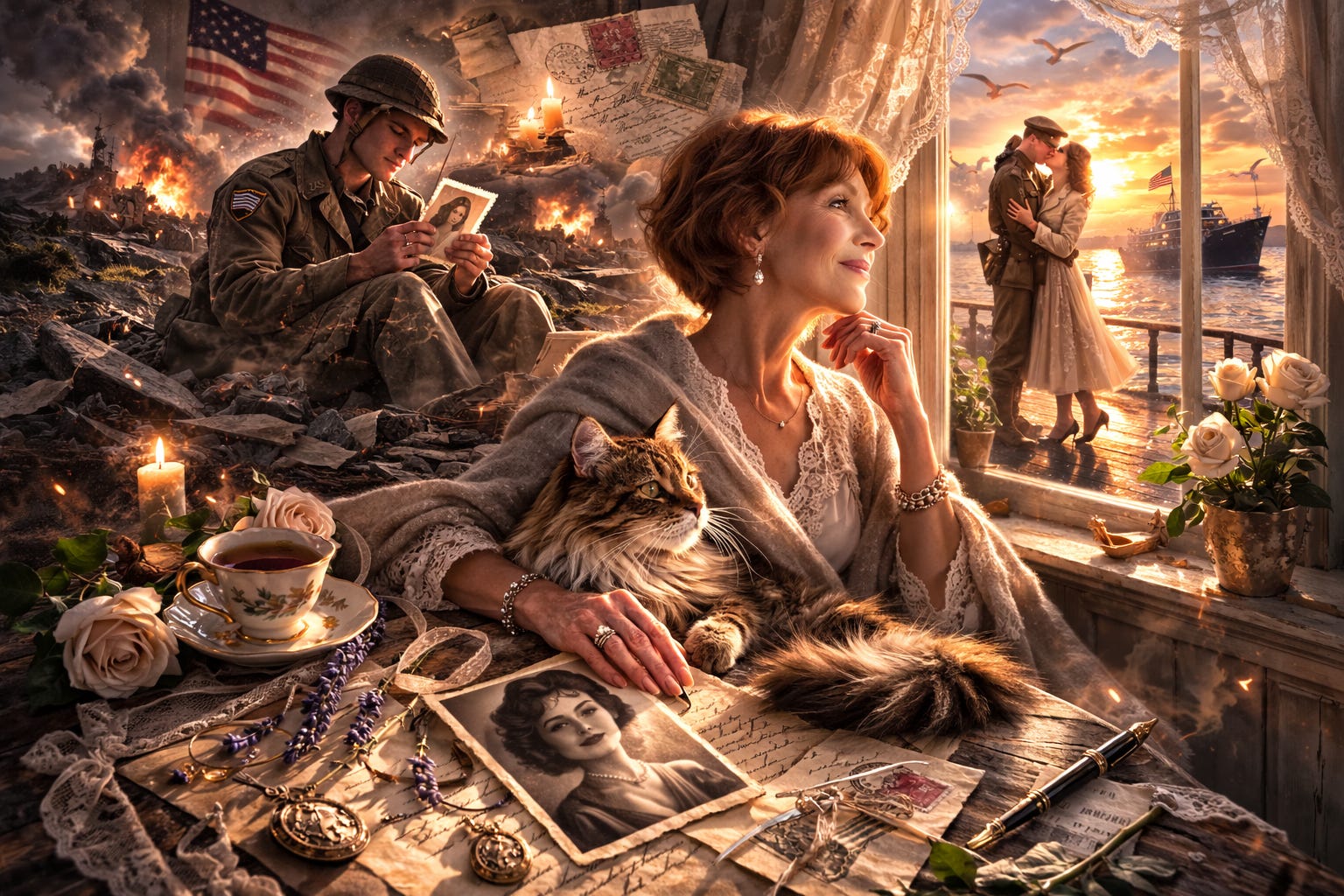
Silver-Screen Beauty, Real-World Rules
I grew up as the firstborn child to a mother who was—unmistakably—beautiful. Not cute. Not merely attractive.
Beautiful in the way the stars of her era were beautiful. Elizabeth Taylor. Hedy Lamarr. Ava Gardner. Perfectly refined lips, sculpted cheekbones, dark hair that looked like it had been designed for close-ups. The kind of beauty that belonged to the silver screen—cinematic, unmistakable, and somehow larger than the room.
And beauty like that doesn’t just get noticed. It gets talked about. People gossip—some of it flattering, some of it edged with envy, the way compliments can turn sharp when they’re really a form of comparison. The room revises its behavior. Voices soften. Eyes linger. Rules appear that no one admits are rules.
And here’s the part that matters: my grandmother—her mother—wasn’t beautiful in that same, capital-B way. Her sisters were. Which means beauty, at least in my line, wasn’t simply a face you happened to have. It was a social force you learned to navigate. A frequency you were trained to respect. A kind of unspoken policy.
So when people talk about beauty like it’s vanity, I feel a little… skeptical. Vanity implies self-obsession. As a child, I didn’t understand vanity. We were blue-collar—proud and practical. Beauty wasn’t worshiped for ego; it was respected the way you respect good shoes: because the world can be hard on your feet.
By the time my teen years arrived, I understood the rules.
Calabria, Survival, and the Inheritance of Beauty
And part of those rules came from where the women in my line came from.
My grandmother came from Calabria as a girl—alone—during the Depression era. The focus wasn’t glamour. It was survival in the new world. Work. Marriage. Making things hold. When survival is the religion, beauty becomes either a luxury… or a tool. And in families like mine, I think it quietly became the tool: a way to secure steadier treatment in a world that could be harsh—especially to women.
What Did Your Nervous System Learn?
If you grew up around beauty—your own, your mother’s, your sister’s—here’s a question I want to offer gently, like a cup set down on a table:
What did your nervous system metabolize about beauty?
Did it learn, I am safe when I am admired?
Did it learn, I must be pleasing to be protected?
Did it learn, attention is love—or did it learn, attention is danger?
Because beauty is never merely the surface. It’s what the surface does to the room. And what the room does back to you.
My mother didn’t give me a lecture titled Beauty Matters. She didn’t have to. Her life was the lecture.
“Is He Handsome?”
When I started dating, she didn’t ask the usual parental questions—the ones meant to sound civilized: Is he kind? Is he stable? What does he do? Does he have goals?
She asked, very simply: “Is he handsome?”
There was comedy in it, of course. I can hear the modern world clutching its pearls. But her question wasn’t as shallow as it sounds. It was an old-world question disguised as shorthand.
Because what she really asked—without saying it—was something like:
Will the world treat you better with him beside you?
Will you feel proud? safe? chosen?
Will you have leverage you don’t have to announce?
And also, if we’re being honest, another question she didn’t ask but probably meant: If he is not handsome, will he punish you for being beautiful?
That last question is impolite. It’s also real enough to have shaped generations of women’s instincts.
A Photo in Wartime: Beauty Met by Devotion
And to be fair to my mother, her idea of “handsome” wasn’t only a preference. It was shaped by the kind of love story that teaches your nervous system what goodness looks like. She was twenty—young enough to still be forming her life, old enough to understand how quickly life could be taken. A friend asked her to write to a cousin, a soldier in the United States Army stationed in Germany during World War II. She wrote. She sent her photo. And my father carried that image like a small passport to the future—something human to touch while bombs exploded and the world felt breakable. He came home and married her. He adored her with the steady reverence of a good man. And that, too, is part of the lineage: beauty can be met by hunger… or it can be met by devotion.
Beauty Isn’t Decoration. It’s a Boundary.
Beauty isn’t decoration. It’s a boundary.
Here’s what I’ve come to believe: beauty, at its healthiest, is a boundary technology. A velvet rope. Not a wall. Not a weapon. A threshold.
Beauty says, wordlessly:
• Come closer gently.
• Bring your best.
• This is not a space where you get to be careless.
In the Velvet Realms, beauty isn’t a performance you do for applause. Beauty is how you curate what gets near your nervous system.
And yes—beauty can be external: the way you dress, the way you keep your home, the way you move through a room. But it’s also internal. Beauty is an atmosphere. A standard. A refusal to be handled roughly.
If you’ve ever felt your body tighten when you walk into a room—before anyone says a word—then you already know: beauty is not just seen. It is sensed. It’s chemistry. It’s history. It’s memory.
Elegance vs. Exposure
The mistake we make—especially now—is confusing beauty with exposure.
We live in the Overshare Era, where people mistake disclosure for intimacy and confession for credibility. Where “authenticity” can become a kind of soft coercion: if you don’t show everything, you must be hiding something.
But elegance isn’t hiding. Elegance is choosing.
And choosing is a boundary.
Some people don’t want closeness. They want access. They want the inside of you as content. They want your tender places explained, packaged, and made convenient. And when you don’t provide it, they call you guarded—as if being guarded is a moral failure.
I don’t think guarded is the right word. I think the word is sovereign.
The Commandment and the Cage
My mother’s commandment wasn’t vanity. It was survival dressed nicely.
Looking back, I can see how beauty became a kind of moral instruction—especially among women who learned early that the world grades you before you speak. My mother’s “handsome” question wasn’t only about romance. It was an attempt at stability in a world where women are often punished for being powerless.
Sometimes the commandment of beauty is really the commandment of safety. And sometimes it becomes a cage.
Because if beauty is treated like a commandment, you can start believing you’re not allowed to be tired, or plain, or complicated. You start believing you must remain presentable even when you’re grieving. You become a museum exhibit of yourself.
You smile as a reflex. You fix your hair as an apology. You treat your body like a public-facing website that must never be under construction.
That’s not beauty as a boundary. That’s beauty as surveillance.
So I’m trying to take the inheritance and keep only the part that heals.
When the Glow Fades, the Real Beauty Speaks
There’s a quiet mercy in getting older: the mirror stops being the whole courtroom.
Youthful glow is a kind of light, yes—but it’s also a fragile kind. It can be stolen by stress, by grief, by sleepless years, by life simply being life. And when that particular light changes, it can feel like the culture gets bored with you, as if your value was a candle and the wax is running out.
But beauty doesn’t disappear. It moves.
It goes where it has always wanted to go: into presence. Into kindness. Into the way someone treats a stranger who is exhausted. Into the way a person listens—fully, without rearranging your words to fit their ego. Into the way you speak to yourself when no one is watching.
And here’s another question, just as gentle, and maybe even more subversive:
Where did your beauty go when you stopped performing it? Did it become your patience? Your honesty? Your willingness to soften instead of sharpen? Did it become the way you stop and really see someone?
There is a kind of beauty that only arrives when you stop trying to win and start trying to bless.
Kindness is not a consolation prize. Kindness is a radiance.
And it does something youthful glow can’t do: it makes other people feel safe near you. Not dazzled—safe. That’s the velvet boundary in its most mature form. Not a spotlight, not a performance—an atmosphere.
The Feline Curriculum
And then there’s the feline curriculum. Living with a cat cures you of certain human delusions.
Cats do not hustle for approval. They do not explain themselves. They do not “show up” for nonsense meetings of the soul. They don’t apologize for needing softness. They don’t pretend to like what they don’t like. They are pure, unapologetic standards.
A cat’s grace isn’t a look. It’s an ethic.
A feline teaches you the truth about elegance: it isn’t exposure, it isn’t silence, it isn’t decoration. It’s discernment in motion. It’s knowing what deserves your warmth and what doesn’t. It’s the ability to leave the room without writing a thesis about why.
And if you live with a feline long enough, you start to realize something both funny and holy: Cats are beautiful because they refuse to be handled carelessly.
In other words, they are living velvet ropes.
And maybe that’s the real lesson my mother was reaching for, in her imperfect human way: not be beautiful so you’ll be chosen, but be beautiful so you remember you are not meant to be handled carelessly.
A Velvet Vow
I’m no longer interested in beauty as an audition.
I’m interested in beauty as a boundary.
A life where my space, my pace, and my presence tell the truth.
Where elegance is not hiding but self-respect.
Where the velvet rope is not a wall—just a gentle shimmering line that says:
Only what is kind may enter before you’ll hear me purring.
For more of my writing, visit: Ellen M Laura
I used to look through my grandparents' photo albums and wonder how everyone was so elegant in those photographs--even those taken during a camping trip. Did everyone in the 1930s, 40s, and 50s and even into the early 60s live their lives by being ready for a photo op? There was a glamour associated with those times that just didn't match my own reality growing up in 1960s, 70s, 80s to present. Have we lost something?