

When Kindness Becomes Camouflage
The Fawn Response, American Liberalism, and the Politics of Appeasement


We keep writing emails to the fire, asking it to please lower its voice.
We light candles. We post “be kind.” We go to a meeting where truth is a little too loud and sand it down until it passes HR. We call this maturity. Our nervous systems sometimes call it survival.
This isn’t a screed against kindness. Kindness is sacred. But appeasement can wear kindness like a velvet cape. I want to name that cloak—the fawn response—and ask, carefully and concretely, whether a large slice of American liberal culture has drifted into chronic, collective fawn: a safety strategy masquerading as virtue.
The Fawn Response, Plainly
We know fight (confront) and flight (escape). Add freeze (shut down) and you have the familiar trio. Fawn is the fourth survival strategy: a pattern of appeasement—people-pleasing, over-agreeing, smoothing, self-shrinking—to stay safe when confrontation or departure feels impossible or too costly. Fawn is active (unlike freeze), but the action is aimed at reducing someone else’s aggression or displeasure, not at protecting our own boundary.
It can look like:
Saying “whatever you want” when you absolutely do not want it.
Over-apologizing to preempt criticism.
Agreeing in public, resenting in private.
Praising an aggressor to dull their edge.
Performing agreeableness until you can breathe.
Fawn is adaptive in unsafe contexts. If you’re trapped with power you can’t fight or leave, appeasement might genuinely keep you alive. Trouble starts when a situational survival script hardens into a chronic stance, or scales up inside institutions that mistake appeasement for ethics.
Two guardrails:
Fawn ≠ “being nice.” Niceness can be generous and principled. Fawn is self-abandoning under perceived threat.
Fawn ≠ freeze. Freeze is immobilization; fawn is socially mobilized to smooth the threat away.
Nervous Systems Don’t Check Party Registration
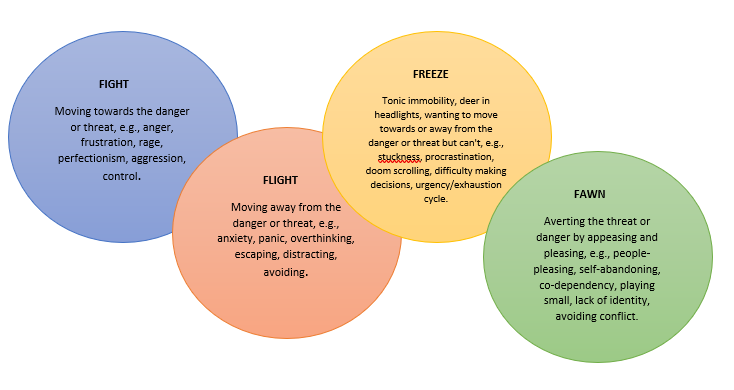
Your nervous system continually scans for safety or danger, mostly below your level of awareness. When it senses a threat, it mobilizes (fight/flight), immobilizes (freeze), or socially appeases (fawn) to reduce risk. These aren’t moral choices; they’re reflexive bids for survival. And they’re trainable. What we rehearse, we default to.
In families, workplaces, and political spaces where civility carries high social capital, approval and belonging often arrive when we make conflict go quiet. The body learns: appeasement = safety = love. Under sustained volatility, we’ll reach for it first.
Micro Fawn vs. Macro Fawn
Micro fawn shows up in our sentences:
“Sorry!” when we mean “Thank you for waiting.”
“It’s fine,” when our stomach drops.
“I can take that on,” when we already can’t breathe.
Macro fawn shows up in organizations:
Pre-negotiating against oneself to look “reasonable.”
Tone-policing allies to preserve comfort over clarity.
Deference to institutions that repeatedly fail to deter harm—“respect the process” at all costs.
Unity rhetoric that treats boundary as hostility and imagines conflict itself is violence.
Any group can slide into macro fawn under chronic threat. But here’s the provocation: Are many American liberals fawning right now?
The Provocation: A Liberal Fawn
This is a hypothesis about behavior, not a diagnosis of millions.
Why now:
Threat saturation. Political whiplash, disinformation swarms, court shocks, climate dread—nervous systems marinate in danger cues. Appeasement offers quick relief: “If we soften, maybe they won’t escalate.” Short-term calm, long-term training: harmony = safety, even when “harmony” costs boundary.
The etiquette trap. Civility can be beautiful. But when conflict capacity is underdeveloped, civility becomes a performance of safety rather than the practice of truth with dignity. We protect the manners and lose the message.
Pre-emptive concession. Seeking middle ground can be strategy. But when the opening move is always a concession made for optics rather than leverage, it isn’t negotiating; it’s appeasing.
Boundary confusion. If you equate boundaries with unkindness, you’ll surrender them to appear good. Without boundaries, truth loses teeth—it can neither protect the vulnerable nor deter predation.
What this looks like in practice:
Retreating from clear statements because someone might call them “divisive.”
Rewarding punditry that says very little very gently.
Treating institutions as sacred after they’ve shown capture or indifference.
Asking the arsonist to critique our smoke alarms in the spirit of bipartisanship.
This is not permission to be cruel. It’s a call to grow a spine on which kindness can stand.
“But Isn’t That Just Strategy?”
Yes: de-escalation, compromise, and coalition-building are essential arts. Conflict without craft is a tantrum, not a movement. The question isn’t “soft or hard?” It’s: Are your boundaries intact while you choose your tone and tactics?
Strategy with boundary: “Here is my non-negotiable. I’m open on methods, not on dignity.”
Fawn without boundary: “Tell me what to give up so you aren’t mad.”
Strategy with transparency: “We’re conceding X to secure Y. If Y is blocked, X returns to the table.”
Fawn with opacity: “We conceded X to appear reasonable; please clap.”
Not sure whether you’re appeasing or iced over? A 90-second litmus: freeze takes your words; fawn lends you someone else’s.
How to Tell If You’re in Fawn or Freeze
Short answer:
Freeze is immobility to survive: your system slams the brakes.
Fawn is appeasement to survive: your system performs safety.
Field guide:
1) First 60 seconds—body:
Freeze: tunnel vision; breath disappears; limbs heavy; words vanish; staring; scrolling without absorbing.
Fawn: sudden social smoothness; warm agreeable voice; over-explaining, over-thanking, over-smiling; nodding yes while your gut says no.
2) Intention → effect:
Freeze: not chosen; the body hits the kill-switch → inaction (silence/withdrawal).
Fawn: chosen to keep them okay so you feel safer → action—but placating (agreeing/praising/conceding).
3) Aftermath (10–30 min):
Freeze hangover: shame for not acting, hazy memory, fatigue, tears when safety returns.
Fawn hangover: resentment, boundary regret, people-pleasing debt (“Now I must deliver what I never wanted”).
4) Language clues:
Freeze-ish: “I… um… I need a minute.” Or nothing.
Fawn-ish: “Totally! Happy to.” “Whatever works for you!” (while your stomach knots).
5) Time course:
Freeze often resolves when danger passes or a regulating cue arrives.
Fawn can become a script—smoothing, volunteering, apologizing for days.
6) Agency test:
Ask: “If I were perfectly safe, would I be doing/saying this?”
No + doing nothing → likely freeze.
No + doing something to keep them calm → likely fawn.
Micro-interventions (right now):
If freeze: Name it—“I’m going blank.” Move a little: feet into floor; look left-right-left. Borrow words: “I need 5 minutes. I’ll circle back.”
If fawn: Buy a breath—“Let me think about that.” Swap phrases:
“Whatever you need” → “Here’s what works for me.”
“I can take it” → “I’m at capacity; here’s an alternative.”
Repair if needed: “I said yes quickly earlier. I need to change that to a no.”
30-second body scan (quick sort):
Eyes: frozen stare (freeze) vs. over-attentive warmth (fawn).
Jaw: slack/heavy (freeze) vs. smiling/over-agreeable (fawn).
Hands: cold/still (freeze) vs. busy/soothing (fawn).
Breath: barely there (freeze) vs. chatty breath riding your words (fawn).
Gut: numb (freeze) vs. tight but performing “okay” (fawn).
Rule of thumb: If you can’t act, support movement. If you can act but keep appeasing, support boundary.
Is “Watching YouTube from the Safety of Home” a Fawn Response?
Sometimes, but not automatically.
Fawn-adjacent: appeasement by withdrawal—staying publicly silent while privately consuming content that soothes anxiety about speaking. It sends a message to the perceived threat: “I won’t make a fuss.” Short-term relief; long-term entrenchment.
Freeze: overwhelmed and immobilized—doom-watching as paralysis.
Flight: avoidance—escaping into analysis instead of acting.
Regulation: intentional step-back to down-shift arousal, learn, and return with clarity. That’s wise, not fawn.
Heuristic: If your YouTube retreat restores you to truthful action (call a representative, attend a meeting, write the scary piece), it’s regulation. If it replaces action indefinitely and your silence buys social safety, you’re likely rehearsing a fawn-freeze blend.
Ask yourself:
What threat am I appeasing by staying quiet or small?
What boundary am I protecting or abandoning by not speaking?
What one tiny, truth-aligned action would break the spell today?
Ethics and Precision (So We Don’t Turn Pop Psych into a Weapon)
“Fawn” is a survival pattern, not a moral identity or a clinical label. It emerges from histories—personal, familial, cultural—where appeasement kept the peace or kept you alive. The goal isn’t shaming; it’s increasing choice. See the script; decide whether to run it.
Avoid:
Armchair diagnosing whole groups as “trauma-bonded” to score political points.
Shaming people for strategies learned in coercive or precarious environments.
Confusing high agreeableness (a trait) with self-abandonment under threat (a pattern).
Exiting Fawn: Personal and Political
If appeasement is a cloak, here’s how to take it off and keep the warmth.
Personal nervous-system practices
Orienting: Name three colors, three sounds, three textures. Signal: I’m here. I can look around. I’m not trapped.
Breath pacing: Lengthen your exhale. Five slow cycles before a meeting often shift you from appeasing to grounded.
Co-regulation: Sit with someone who can tolerate disagreement without punishment. Safety is contagious.
Micro-exposure to conflict: One tiny truth a day. A clean “no” to a low-stakes request. A precise “yes” with limits. Reps build capacity.
Language upgrades (keep the music, change the words)
“Whatever you want” → “Here’s what works for me; what works for you?”
“Sorry for the delay” → “Thanks for your patience—here’s my timeline.”
Hedge → “I see it differently. Here’s why.”
Private rage/public silence → “I disagree, and here’s my boundary.”
Collective practices (how movements keep a spine)
Boundary statements: “We welcome debate. We don’t trade away people’s safety to purchase quiet.”
No pre-negotiation: Stop giving away the store to look “adult.” Begin with what you mean, then negotiate with leverage.
Conflict-capable culture: Train leaders and members in structured disagreement and fast de-escalation that preserves truth.
Receipts over vibes: Track outcomes. If civility rituals don’t protect the vulnerable or advance goals, change the ritual.
Media hygiene: Replace doom spirals with intentional cycles: learn → act → rest → reconnect. Watching isn’t wrong; watching instead of acting is the tell.
Kindness with a Backbone
A closing plea to my own nervous system and, maybe, to yours: Let mercy keep its teeth. We don’t have to become cruel to stop appeasing. We can keep our gentleness and upgrade our boundaries. We can practice a tone that honors dignity without surrendering clarity. We can leave the YouTube hearth, take one steady breath on the cold porch, and say the necessary thing—soft-voiced, sure-spined.
If civility demands your silence, it isn’t civility; it’s leash training.
If a strategy requires self-abandonment, it isn’t a strategy; it’s fear in formalwear.
If kindness costs the truth, it isn’t kindness; it’s camouflage.
This week’s experiment:
Name one boundary you’ve been sanding down for safety. Write one clear sentence that restores it. Say it—gently, directly—to one person who needs to hear it. Then notice what your body does. Notice if the sky falls. (Spoiler: it won’t.) Notice, too, the small, fierce joy of being intact.
Kindness deserves a spine. Let’s give it one.
Learn more about the author, Ellen M. Laura