

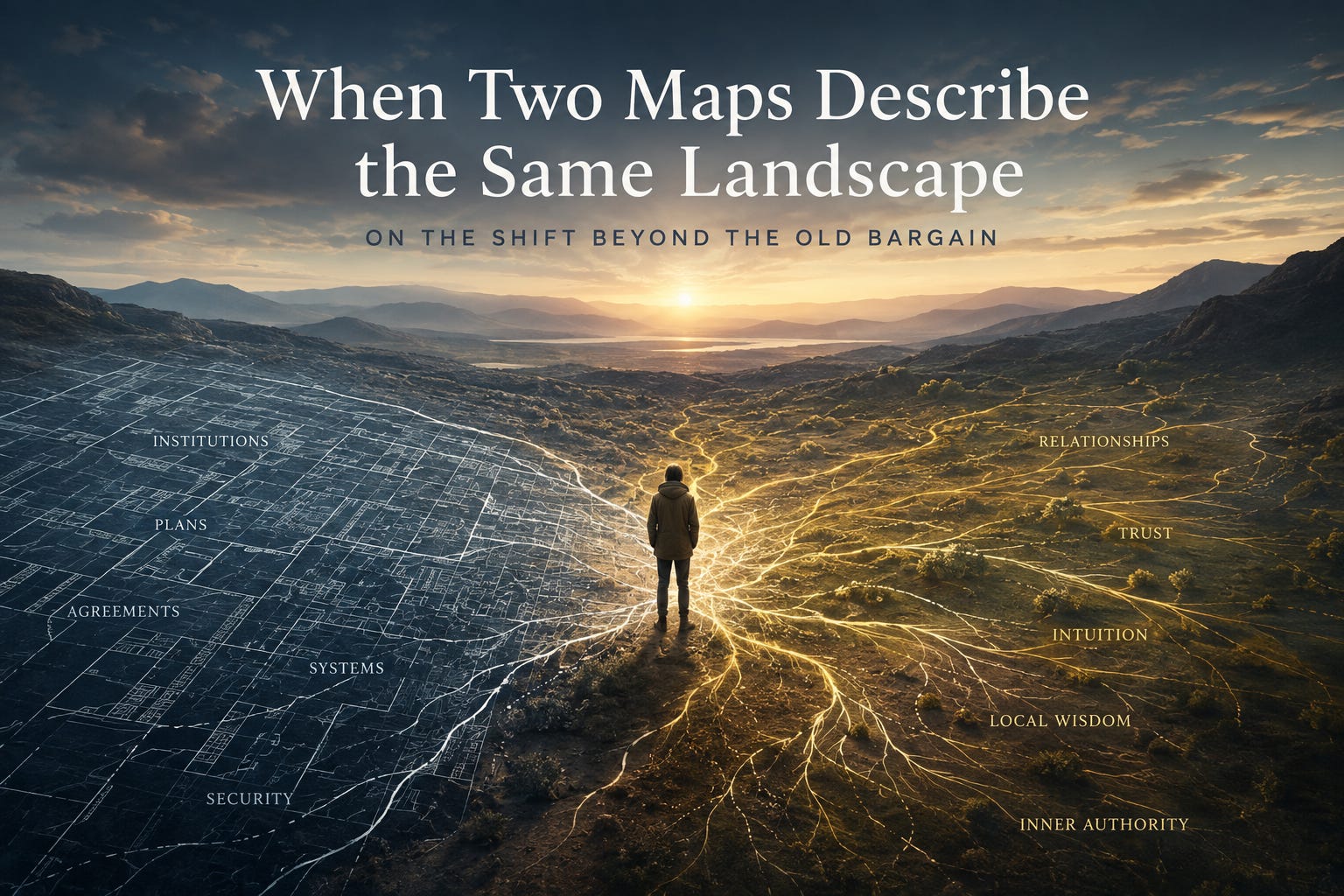
There are moments when two different ways of seeing the world begin describing the same terrain.
That happened to me recently while reading an essay titled "Mutation" by Adrien Lelièvre.
His perspective is secular: institutions, complexity, human behavior, information overload. Mine includes something quite different—the Human Design teaching about the 2027 shift, when we move out of the Cross of Planning, a cycle that has shaped collective life for more than four centuries.
The two systems don’t agree about why change is happening.
But they have some surprising agreement about what it may feel like.
For generations, most of us have lived inside an implicit bargain:
Participate in the system, and the system will support you.
Work hard, and the company will take care of you.
Pay your taxes and institutions will function.
Trust the hospital, the school, the government, the experts.
Keep your agreements, and others will keep theirs.
Of course, this was never entirely true. But the bargain was powerful enough to build societies around it.
Human Design calls this the era of the Cross of Planning—an age deeply concerned with cooperation, agreements, infrastructure, support, and tribal survival.
The cycle beginning in 2027 has a very different flavor.
More individual.
Less dependent upon collective agreements.
Less certain that the old structures will continue carrying us.
Lelièvre arrives at something remarkably similar from another direction. He argues that institutions eventually become so large and complex that they stop responding effectively to human needs. People don’t necessarily storm the castle. They simply begin withdrawing their trust.
And I wonder if we are already feeling that withdrawal. Not only politically or economically.
In the nervous system.
The Body Knows When the Map No Longer Works
One of the most exhausting conditions for a nervous system is unpredictability.
You make the correct call and receive the wrong answer.
You follow the instructions and discover the instructions have changed.
You send the form, make the appointment, contact customer service, check the account, read another headline—and somehow nothing feels settled.
The mind says:
I should be able to figure this out.
The body says:
I no longer know what is safe.
That distinction matters.
We tend to think uncertainty is primarily an intellectual problem. If only we had better information, we could make the right decision.
But information itself has become part of the overwhelm.
There is always another expert. Another headline. Another warning. Another study contradicting the previous study. Another person insisting that only a fool would believe what the other half of the population considers obvious.
Eventually the nervous system does something very sensible.
It becomes tired.
We call it anxiety, irritability, numbness, distraction, insomnia, or overwhelm.
Sometimes it may simply be the organism saying:
I cannot process this much uncertainty anymore.
The End of the Bargain Does Not Have to Mean the End of the World
This is where I find the word "mutation" more useful than "collapse".
Collapse makes us imagine catastrophe. Mutation suggests something more mysterious.
A form has reached the limits of what it can become, and another form is beginning to emerge.
The old institutions may remain. Governments will not vanish on January 1, 2027. Hospitals will still open their doors. Schools will still teach. Companies will still hold meetings that could have been emails.
The change may be much subtler.
We may simply stop assuming these structures can tell us how to live.
And that creates both freedom and fear. Because there is comfort in having a clear map to follow.
If the Outer Authority Weakens, What Becomes Stronger?
Human Design has always returned to one deceptively simple principle:
Can you make a decision from your own inner authority rather than from conditioning, fear, or pressure?
That question may become increasingly important. Not because everyone should become fiercely independent or retreat into some bunker with twelve cans of beans and a solar charger.
We need each other. But community is different from dependency.
Perhaps the new landscape asks us to become more discerning about where we place our trust.
Who actually knows us?
Which relationships are reciprocal?
What information does the body recognize as true enough to act upon?
What agreements are still alive—and which ones are being maintained simply because no one has admitted they died three years ago?
These are nervous-system questions as much as philosophical ones. A regulated nervous system doesn’t mean we never feel fear. It means fear does not automatically become the authority.
Smaller May Become More Beautiful
One possibility in Lelièvre’s essay particularly interested me: as giant systems lose credibility, people may begin creating smaller networks of trust.
People they know. Places they can understand. Communities where actions still have visible consequences.
Human Design’s 2027 material is perhaps less romantic about this. The coming cycle is intensely individual. We shouldn’t assume the collapse of large tribes automatically produces happy little tribes.
Still, I suspect something important may happen at the intersection.
We may become far more selective. Not everyone is my community.
These people are.
Not this institution will protect me.
This relationship has demonstrated trust.
Not the experts know.
I will listen, question, feel, discern, and decide.
There is an intimacy in that. And perhaps an honesty we’ve been avoiding.
We Don’t Need to Know Exactly What Is Happening
I remain skeptical of anyone who claims to know precisely what the next decade will bring. That includes political forecasters, futurists, spiritual teachers, and algorithms. But I am fascinated when very different systems begin describing the same landscape.
One says civilization is reaching the cognitive limits of centralized planning. Another says we are completing the Cross of Planning.
One speaks about institutional saturation. Another speaks about an evolutionary mutation.
Different maps. Same strange weather.
In my recent podcast, I spoke about the Solstice as a threshold—a time to notice what is ending and what is still asking to live. Sometimes that threshold arrives gently. Sometimes it arrives as a storm.
What has the storm sent tumbling away? And what will future storms destroy?
An agreement? An identity? A relationship to authority? A way of living that once felt secure but no longer fits?
And after a storm, what is still alive?
Perhaps it’s this:
If the structures around you become less reliable, what inside you must become more trustworthy?
That may be one of the deeper invitations of this time. Not to predict the future. Not to cling desperately to the past.
But to become a little more capable of standing in uncertainty without abandoning ourselves.
One hand touching the mystery. And the other hand washing the cup.
I just got home and saw this. I shall take some time to read, for my curiosity is leading me. I know things will spark my biological imagination 💧💦🐬